Friday, July 17, 2015

Arched Tomato Trellis

Luckily my tomatoes are doing well this year. In fact they are outgrowing their trellises which are about 6 ft tall.
We still have months left in the growing season, so it's time to extend the trellises. I have been fantasizing about an arched-shaped trellis covered in tomatoes since last winter. I built the arch using wire concrete reinforcement panels. They are approximately 4 ft x 7 ft and are made of rigid wire with a 4 inch grid. 

I attached the wire sheets onto my trellises and reinforced the center with 1 x 2's.
This trellis is ten feet long so I used two wire panels. I attached the panels to the outermost horizontal 1 x 2's using wire. 
It was clear that the arch needed to be supported in the middle so I used a 
1 x 2 that's about 6 feet long. I put it at the center of the arch and held it up with two vertical posts. At the highest point, it is about 7 ft high.
We have to be careful not to kick the vertical posts when we walk underneath. Sometime later, I may wire it together at the top for more stability, but for today, this is how it stands...ready for the tomatoes to grow.
...and it's all worth it for this.
Black Krim


Sunday, July 12, 2015

Kamo Eggplant

Kamo eggplant is a baseball-sized treat, round and small. We used this one to make eggplant parmesan and it was just enough for the two of us. Unfortunately, that meant no left-overs for lunch the next day. My, it was delicious!
I find these plants to be so beautiful with their velvet leaves of purple and green.
This variety is especially showy as the purple is a deep color which creates a spectacular contrast against the green leaves. Kamo is attractive enough to plant it as an ornamental.
Pretty purple flowers hang gracefully.
 But don't let their beauty fool you. They are protected by thorns.
A wonderful eggplant, Kamo is shiny enough to reflect the blue sky.


Friday, July 10, 2015

Pepper Sunscald

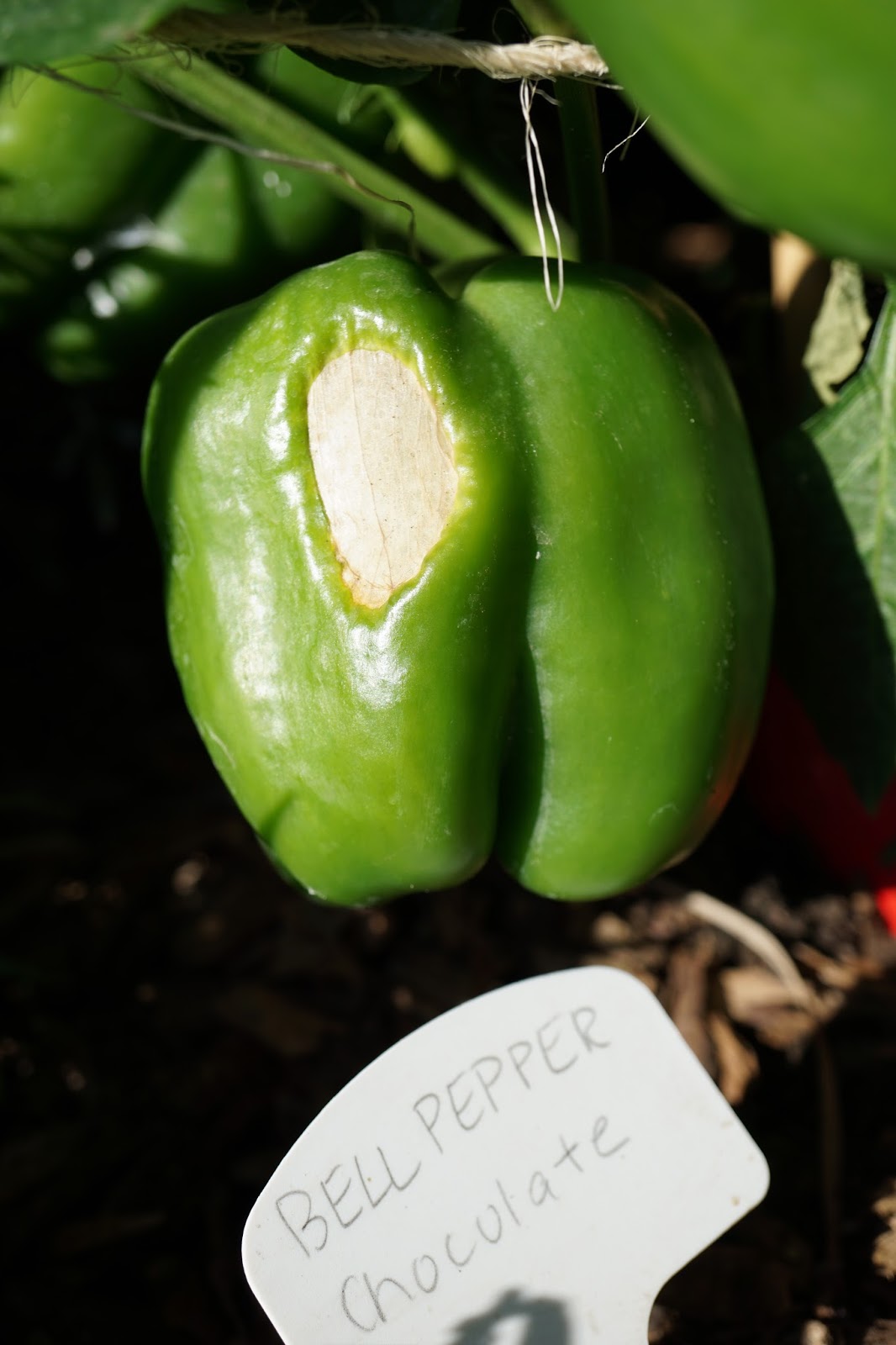
Ever have this happen to one of your peppers? You go out one day and there it is...a scar on your pretty pepper. Even peppers can get a sunburn. Too much sun and the flesh is damaged, leaving an indented, pale, tough spot. Sometimes the spots will crack and the pepper will go bad. Other times, the blemish just remains there while the pepper continues to grow. The pepper is still edible, just remove the scar and eat the rest. 

The healthier the plant, the less likely the peppers are to be scalded. If the plant has bushy leaves, the peppers will be shaded by the leaves, protecting them from the sun. Even the healthiest plants leave some fruit uncovered. In the center of this photo, you can see a vulnerable pepper next to the stick.
A closer look reveals minor sun damage. 

The skin is dimpled and pale. If left unprotected, this spot would become a deep scar.

The solution is to cover or shade the peppers. I used shade cloth and poles to provide some shade.
Simply use wire to tie the cloth to the posts.
The shade cloth does not block the sun completely and the plants will get enough sun during the morning to grow nicely. They just need protection during the heat of the day. I installed the shade cloth during the hottest hours of the day to make sure the cloth was at the right height and angle to give the plants shade during those hot afternoon hours.
They look happy under the shade cloth.
Here's another area where I'm growing some peppers. Improvisation is key.
In another spot, the peppers are shaded by cloth and some dead bamboo sticks I stuck in the ground to protect them from the side.
See the peppers under there? No sunscald to be found!

Here's to a bountiful and beautiful harvest!


Tuesday, July 7, 2015

Spider Mites

Spider mites, oh how I despise you! You are killing my cucumbers, attacking my beans and herbs. Go away!

For the past several years the spider mites have been a big issue in my garden. They are tiny little insects that tend to live on the underneath surface of leaves, and they suck moisture from the leaves, slowly starving the plant. 

Here is a bean leaf with minor damage. Notice the tiny light dots. 

Here is a leaf with slightly more damage. Notice more light areas, and the leaf has a dusty or dull appearance.

 Here is the underneath surface of the same leaf. You can see tiny dark specks. Sometimes you can also see fine spider webs.
 This cucumber leaf is severely damaged and will soon dehydrate and die.
The underside is almost white.
Hot dry conditions are what they like. I guess living in Los Angeles makes them happy because they are thriving at my house. 

They do have natural predators but apparently the mites are winning the battle in this urban garden. To combat them I will spray with soap and water every few days. On the other days I'll spray down the vines with water which knocks some of them off, and discourages them because they don't like moist conditions. I have removed the infested leaves too. 

Time will tell if the cucumbers can be saved. 

What tips do you have for combatting these pests?  I hesitate to use Neem oil since it tends to burn my plants in our heat. I need all the help I can get!


Thursday, July 2, 2015

Tomatoes with Basil on Himalayan Sea Salt Block

Never have I ever had such flavorful tomatoes. Ever. Homegrown tomatoes are worth the effort, aren't they? If fresh tomatoes are your thing, you must try seasoning them on a salt block. Imagine turning up the flavor to the point it is almost too intense. That's what the salt block does. 

The build-up started in winter, painstakingly choosing tomato varieties out of seed catalogs, dreaming of tasting the first one of the season. Now, after all that time and concern, the fruit of our labor is ripe! 

This Cherokee Purple tomato is like a work of art, perfectly round and deeply colorful. It is my third tomato of the season. Oh, they are precious, those first few. It tasted even better than my imagination.

Luckily for us, our daughter bought her dad this Himalayan salt block for Father's Day. 

It was a perfect gift for him. He loves cooking and cooking gadgets, trying new recipes and experimenting. We had never heard of cooking on a block of salt. Apparently it's a thing. There are whole cookbooks about it. Ours is about 1 1/2 inches thick and it rests in a metal tray. When it was new it was pale pink, now it is stained from using it to cook meat on the barbecue. 

It is incredible how the salt block intensifies the flavor of the tomatoes. Just place the slices on the block for one minute per side (or less) and sprinkle some chopped basil on top (or not). The juice of the tomato causes the salt block to melt a bit, evenly infusing the tomato with salt. 

I tell you, the flavor will knock your socks off. 

Thank you, dear daughter, for the Father's Day gift.
Love, 
Mom