Showing posts with label lettuce and greens. Show all posts

Tuesday, January 27, 2015

Growing Cilantro

Cilantro is probably my favorite herb. That might be due to my love of Mexican food which often features this tasty plant. It is the one thing that we always have growing in the garden. My garden is productive all year, and by sowing cilantro seeds every month or so, I have a continual supply of delicious fresh cilantro. Lucky is the Southern California gardener! 

Plant the seeds 1/4 inches deep. Seed packages recommend spacing them 12 to 18 inches apart. I plant mine closer together because usually we eat them before they get large enough to go to seed. Mine are usually spaced 8 - 10 inches apart. I tend to plant the seeds around the perimeter of my beds. Here it is growing at the edge of this bed.
Usually I will plant about 8 plants at a time because that is the amount that we use for a month. This way we have a good supply but not so much that it goes to waste. I start planting seeds in one area of the perimeter, then the next month I plant further along the edge. That way I keep planting the seeds where cilantro has not been growing recently, moving clockwise around the edge of the bed. Rotating crops will help to prevent depleting the soil so the plants will be healthy.

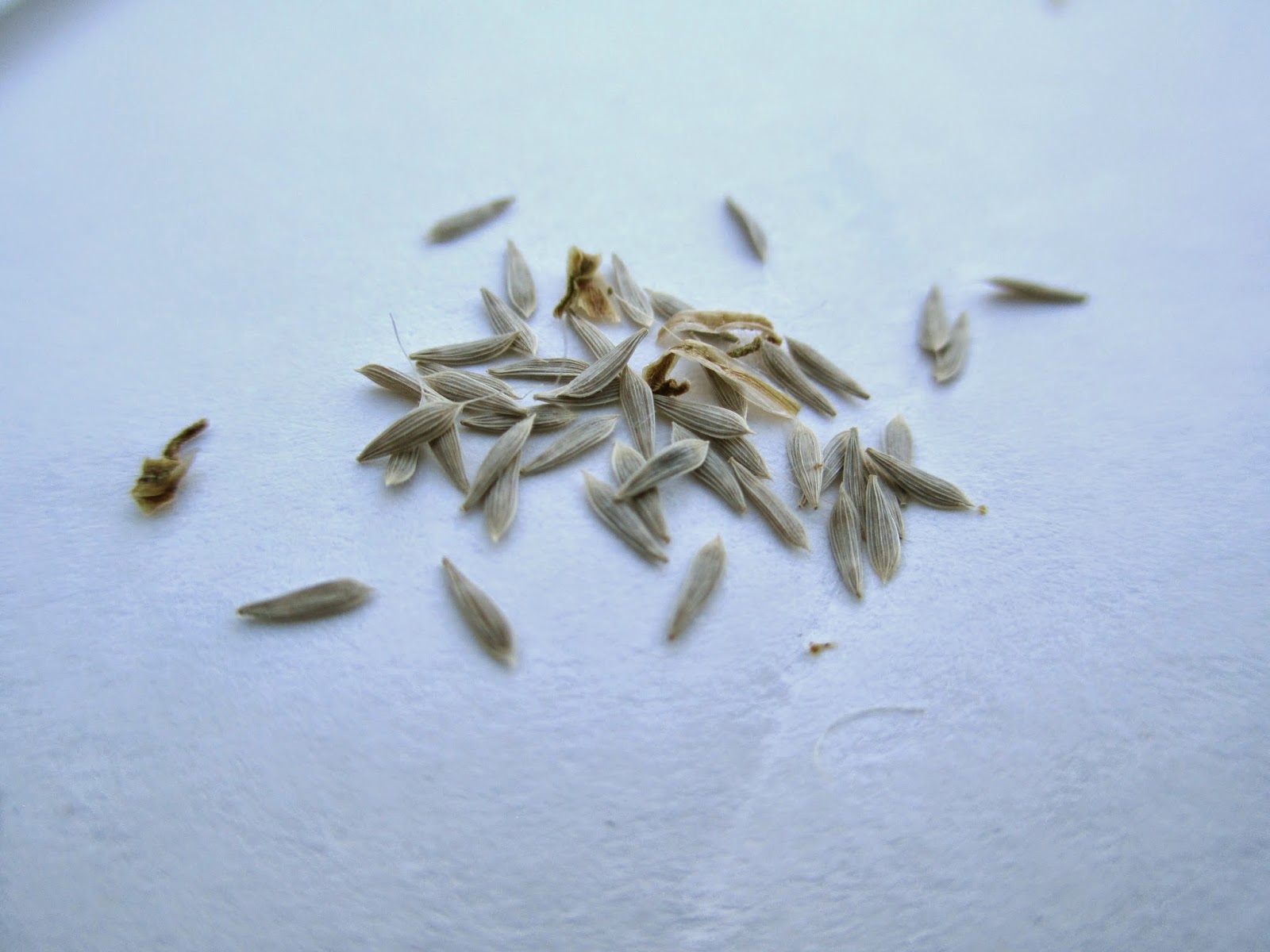
The seeds of the cilantro plant are also used for cooking and are referred to as coriander. The plant is an annual, so periodically I let one plant go to seed so that the seeds can be collect to be planted later, and for cooking. The bees absolutely love the cilantro flowers which is another reason to let it go to seed. The more bees, the better!
Taken in June, this cilantro was 4 feet high and covered with tiny white flowers, and bees. (Sorry for the poor photo quality.)
Like most herbs, cilantro prefers full sun, well-drained soil and regular watering. It does best in the cool months of spring and fall. In areas with hot summers it does best in partial shade. During our very hot summers, I plant mine in the shade of the tomatoes as seen above. In warm winter areas (zones 8, 9, 10), fall planting results in vigorous plants all winter. 

The plants tend to grow quickly and it is best to harvest the plants while young. Harvest the leaves by pinching off the stems while taking care not to uproot the plant. You can prolong the harvest by taking only some of the leaves from each plant rather that stripping the whole plant at once. The plant will continue to produce leaves if you don't take all the leaves at once. 

Soon the plants will bolt, sending up flower stalks. While producing the flower stalk, the leaves become sparse. At this point, you can let the plant go to seed, or dig it up to make room for something else. I usually don't let flower stalks form unless I want to collect the seeds because the plant is taking nutrients from the soil and is really not producing good leaves anymore. One large plant that is left to go to seed will produce hundreds of seeds.

This is a plant which will reseed freely. In my garden it comes up everywhere, and that is fine with me. Right now it's growing in my compost pile.
It's happy to volunteer in the onion patch.
Why not grow around these bulbs?
I guess some people would consider this tendency to reseed a problem. Not this gardener. I need lots of cilantro to satisfy my cravings for guacamole!


Sunday, January 25, 2015

Upland Cress - Winter Cress that Requires No Stream

Upland cress is a delicious spicy green, and it's packed with nutrition. It is similar to watercress but Upland cress can be grown in the ground making it easier to grow in the garden. Since mine is looking so luscious, it is time for me to share some photos before it gets eaten. My husband loves spicy greens like arugula and Upland cress. He puts them in sandwiches, soups, sauces and of course in salads. They add a peppery kick, and in our family we all love a little spice. To tone down the intensity of the taste, many people prefer cooking them rather than eating them raw. 

One look at the plant and the dark shiny leaves just scream healthy nutrition. It is the darkest of the leafy greens in my garden.
Upland cress (Barbarea verna) is packed with vitamins A, C, E and K. Years ago it was used to treat scurvy as it has more vitamin C than oranges. It is known to fight cancer by raising antioxidant levels in the blood and by protecting DNA from damage. Folate and potassium are also present in this tasty green. It contains lutein for eye health, as well as iron and calcium. It can act as a mild diuretic and has been used as a folk remedy for healing wounds. Upland cress is a power food and it is easy to grow in the garden.

This is a cool weather green, and I treat it like lettuce. It is planted in the fall in the shade of my bush peas. 
You can see it at the far right in this bed. I chose to plant it there because that is the area that gets the most water. Like its cousin watercress, Upland cress likes water. Unlike watercress it does not like to be in soggy conditions. In areas that freeze, sow seeds after the last frost for early spring harvest. In warmer areas, plant it in the fall and enjoy the zesty leaves all winter. 


Wednesday, July 9, 2014

Collecting Seeds for Next Year's Harvest

Lettuce seeds come in tidy packages or atop a towering plant.  
Striving to be more self-sufficient I am determined to collect seeds for next year's garden. My vegetable garden is only in its second year and last year it didn't occur to me that it would be a good idea to let some plants go to seed so that I could collect the seeds. The light went on this spring when I had to buy more seeds. This year I am well on my way to having a nice seed collection for next year.

One of the things I love about gardening is the structure of the plants. I knew that lettuce would bolt (meaning it would quickly grow tall and produce flowers then seeds). I just didn't realize how tall it would become. These Romaine lettuce plants are flowering at 4.5 feet tall. 
The yellow flowers are small but numerous. 
They morph into fluff balls of seeds similar to dandelions.
Each plant is loaded with blossoms so in the future I will only let one plant of each variety go to seed. To leave more than one of each variety is not needed and the extra plants will just be pulling nutrients from the soil as they bolt, so one is enough.

I found that collecting the lettuce seeds was easy. I just pinched off the fluff balls and placed them in my palm.
Then I blew gently to blow away the white fluffy part leaving the heavier seeds behind.
These Romaine seeds are put in an envelope, sealed and labeled, ready for my winter garden.


Wednesday, June 4, 2014

Red Russian Kale

My family loves kale. It goes into my morning fruit shake, and my son eats a bowl-full raw with garlic, avocados and tomatoes as a bedtime snack. Luckily the plants are robust so they just keep producing leaves even though they are picked daily. Other than the occasional aphid attack, mine are healthy and vigorous.
Blue curled leaf kale and red Russian kale

Red Russian kale
Last summer I was given some Red Russian kale seeds. It was new to me, I had never heard of it. I simply must find that acquaintance and thank her because it has become a favorite.

The flavor is more subtle and slightly sweeter than the other variety in my garden which is blue curled leaf kale. The texture is very different because the leaves are flatter although they are still substantial. I love how water just beads off of the leaves when you wash them.

The combination of green and purple is beautiful.
Any plant that brings purple to the party is always welcome. Look at the stems.
It's attractive enough to look nice in a pot on a patio, especially considering its health benefits. High in vitamin C, vitamin K and beta carotene, it also contains cancer-fighting chemicals. 

My favorite way to eat it is to saute it with garlic, nuts (any kind, I love them all) and a little soy sauce served over red quinoa. Delicious!